There is a stretch of road approaching Meschers-sur-Gironde, coming through Talmont, where the landscape suddenly opens and the coast appears.
I had travelled that way before. Many times, probably.
But this time I looked across at the water and felt something I wasn’t expecting.
I could get used to seeing this.
It was nothing more than a passing thought. One of those little sentences that arrives before you’ve had time to examine where it came from.
We were on our way to visit family we hadn’t physically seen for four years.
Four years.
It sounds terrible written down like that.
There had been telephone calls and FaceTimes, of course. There had been Christmas parcels and conversations and all the little ways families remain connected across distance. But life had somehow filled the space between us.
Work. Money. Illness. Children becoming adults. Problems that demanded attention. The ordinary business of keeping a life standing upright.
And four years quietly passed.
The house in Meschers belongs to my husband’s parents, although that description has never really seemed adequate.
It was once his father’s family holiday home. It was sold and, when the opportunity arose in the early 1990s, they bought it back.
His mother was born and raised in Meschers. Her family had been rooted there for generations. Her parents owned and ran a hotel and bar there, which is how a girl from Meschers met a boy from Paris.
They eventually made their life in Paris, where their son was born. He later moved to England, where he met me.
And somehow, over the following three decades, that little house in Meschers became part of my history too.
When our daughters were young, we came back to France regularly. Easter, summer, Christmas, New Year. Sometimes twice a year, sometimes more. We stayed for a week or two at a time and accumulated the sort of memories nobody thinks to record because, at the time, they seem completely ordinary.
Coming back this week, the first thing I noticed was how much had changed.
The long shared driveway behind the house used to be bordered by gardens. I particularly remember an elderly neighbour’s vegetable patch. I loved looking at it.
It has gone.
New owners have arrived. Garages and extensions have been built. Where my memory insists there should be open space, there are now great brick walls.
Time had quite clearly moved on without asking my permission.
Then I walked into the kitchen.
And it stopped.
Everything was where it had always been.
The large buffet. The sink tucked into the corner. The kitchen table.
Even the bright pink polka-dot Laura Ashley tablecloth I had given my mother-in-law years ago was still there.
The seat pads on the chairs had once been gifts from me to the grandparents. Somehow, over the years, they had migrated down the road and were still being used.
And on the fridge were drawings.
Drawings made by my daughters when they were little.
Still there.
Still somehow looking almost as they had twenty years ago.
For a moment, I wasn’t a woman in her fifties standing in my elderly in-laws’ kitchen.
I was a young mother again, arriving from England with two little girls.
Outside were the stone steps where Easter eggs had once been hidden.
One Easter, my eldest borrowed her grandmother’s wellington boots. They were far too big for her, but this apparently wasn’t considered a sufficient reason not to wear them.
She was carrying a beautiful chocolate Easter hen when she stumbled on the steps.
The hen hit the stone.
Before she could even comprehend the tragedy, her toddler sister ran over, picked it up and bit its head off.
Cue absolute outrage.
I can still hear the screaming.
My youngest is now a grown woman.
But apparently somewhere on those stone steps, she is still a toddler clutching the head of her sister’s chocolate chicken.
Upstairs, I found another little piece of us.
The bathroom door lock.
Years ago, during one of my eldest daughter’s spectacular childhood tantrums, she managed to lock herself inside. Her grandfather eventually had to kick the door open.
He repaired the lock afterwards.
Badly.
It is still wonky.
And seeing that silly old lock almost undid me.
Because houses do this.
They remember things we have forgotten to remember.
A few streets away once stood the home of my husband’s grandparents.
They had a beautiful garden that his grandfather tended with enormous pride. At Easter, my husband and his father would hide eggs around it and the grandparents would sit delightedly watching our girls rummage through flowerbeds and bushes looking for chocolate.
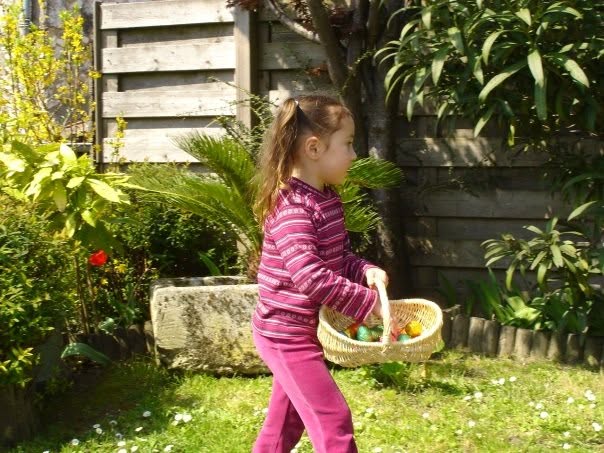
For a man so particular about his garden, allowing those two little terrors free rein through it was perhaps one of his greatest demonstrations of love.
As they grew older, my mother-in-law remained close by to help them.
She did their shopping. Their laundry. The ordinary things that gradually become difficult when people age.
Eventually there came a time when they could no longer remain in their home.
The house was sold.
Before it was cleared, we were asked whether there was anything we wanted.
I asked for one thing.
A large single armoire they had used as a buffet in the dining room.
It wasn’t the most valuable thing in the house.
It wasn’t even necessarily the most beautiful.
But that cupboard was where Mamie kept the goodies.
Whenever we were preparing for the long journey back to England, she would fill it with biscuits, chocolates and treats for the girls. Inside were also old pieces of stationery and pens from the family’s hotel.
To anyone else, it was a piece of furniture.
To me, it was Mamie sending my children home with far too much chocolate.
So I kept it.
Today it sits in the little apartment my in-laws bought many years ago in nearby Saint-Georges-de-Didonne, originally so that their son, difficult daughter-in-law and granddaughters would always have somewhere to stay when we came to France.
Over time, other things from the grandparents’ house found their way there too.
My mother-in-law couldn’t quite say no to them.
The apartment gradually became a little time capsule.
Not everything went there.
This week, standing on my in-laws’ patio, my husband pointed towards an old rabbit ornament.
“That was my grandfather’s.”
I looked at it.
Of course it was.
I recognised it.
The house may have gone, but somehow the rabbit had simply travelled a few streets down the road.
And perhaps that is what families do.
We carry things forward.
A cupboard.
A rabbit.
A chair cushion.
A child’s drawing.
A wonky lock nobody ever quite got around to replacing.
None of these things has much value on paper.
Yet I wouldn’t know how to put a price on any of them.
My in-laws are both 76 now.
Seeing them this week after four years shone an uncomfortable little light on something I had always known but hadn’t yet properly looked at.
They had aged.
Of course they had.
So had I.
But while I had been busy holding my own world together, dealing with work and family and illness and all the things life had thrown at us, they had been quietly growing older in that familiar house by the sea.
The strange thing was that the house hadn’t seemed to age with them.
That kitchen was still holding our younger selves.
Our little girls were still on the fridge.
Easter was still happening on those steps.
A tantrum was still trapped inside that wonky lock.
Mamie was still putting biscuits into an old cupboard.
For a few hours, decades seemed to exist in the same room.
Perhaps that is why I haven’t been able to stop thinking about the coast since we came home.
At first I thought it was simply because it was beautiful.
Now I’m not so sure.
Perhaps what caught me as we drove through Talmont wasn’t somewhere new at all.
Perhaps I was recognising somewhere I belonged.
There will be more visits now.
Not because anyone particularly needs looking after yet, and not because something dramatic has changed.
Simply because four years is too long.
There are still meals to eat around that kitchen table. There are still stories to tell. There are still photographs to take badly and old memories to laugh about.
And there are still new memories waiting to be put beside them.
I’ve spent years surrounded by old things.
I buy them, sell them, photograph them and write about them. I’ve always understood that the things people leave behind can carry something of the lives that came before us.
But this week reminded me of something else.
Sometimes we don’t keep things because they are beautiful.
We keep them because they know who we used to be.
And occasionally, when enough years have passed and life has become very busy, we need them to remind us.
A house remembers.
Even when we forget.
And sometimes, if we are very lucky, we get to go home and add another chapter. ❤️


Leave a comment