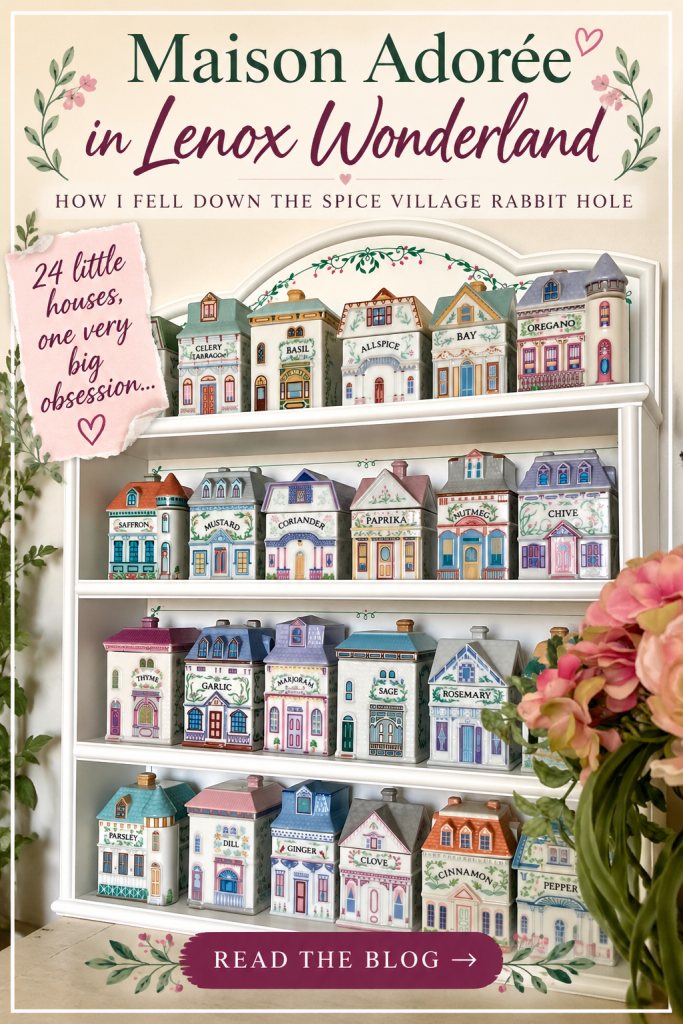
I sell houses for a living here in my little corner of the Dordogne in France — the Périgord Noir, to be exact. A region famed for its old honey-coloured stone houses, some spanning centuries, scattered amongst lush green valleys, walnut groves and rolling countryside.
Houses are, quite literally, my everyday life.
But sometime towards the tail end of 2023, I found myself lusting after a very different kind of house.
It started, as these things so often do, with an innocent scroll through Instagram.
I can’t remember the name of the account. I wish I could. What I do remember is a woman pottering around her kitchen against a pretty pastel-coloured backdrop. She was putting a tiny ceramic house onto a pink wooden rack.
The caption was something along the lines of:
“I painted the shelf pink to match the spice houses I inherited from my grandma.”
I leaned in.
What are those?
There, sitting on her newly painted shelf, was the cutest little ceramic house — intricately decorated, slightly whimsical, and surrounded by neighbours that were every bit as lovely.
They weren’t just ornaments.
They were spice jars.
Twenty-four tiny houses, each representing a different herb or spice, together forming something called the Lenox Spice Village.
And that was it.
Down the rabbit hole I went.
One search became another. I wanted to know when they were made. What the different houses were called. Why some looked slightly different from others. What the marks underneath meant. Why some said Lenox and others Brooks & Bentley. Why some roofs looked different. Why some flowers were delicate little buds and others were… well, blobs.
I didn’t know it then, but I had just acquired an entirely unnecessary new area of expertise.
And what followed became considerably more ridiculous than one Instagram reel had any right to cause.
There have since been original houses, re-released houses, three different versions of the same bloody Thyme house, shelves, parcels, negotiations, trades, unexpected finds, international shipping and an encounter with French customs that I would prefer not to relive.
There has also been an alarming amount of time spent examining the bottoms of tiny ceramic buildings.
Or, as they have become known in our house:
the bums.
So perhaps Lenox Spice Village Journey is too sensible a name for all this.
Because there have been several moments along the way when I have genuinely wondered whether I have completely lost my marbles.
But I’ve also learned an enormous amount about these 24 little houses — their history, their variations, the originals, the re-releases, their markings and all those tiny details that I now can’t help noticing.
And frankly, all that information cannot remain rattling around inside my head indefinitely.
Something has to be set free.
The marbles or the houses.
So, for the sake of my sanity, we’re starting with the houses.
Welcome to my Lenox Spice Village rabbit hole.
And because one article could never adequately cover everything I’ve discovered — or all the trouble these little houses have caused — this is going to be a series.
We’ll explore the original 1989 collection, the 2024 re-release, the different markings and variations, the mysteries of Brooks & Bentley, and the little details that can make identifying a house surprisingly complicated.
There will also be stories of collecting, buying, selling, shipping mishaps and the occasional rather expensive lesson learned along the way.
Some posts will be practical guides. Others will simply be tales from the rabbit hole.
And if you’ve found yourself wondering about the differences between one tiny porcelain house and another, you are very much in the right place.


Leave a comment