Only 23 Left to Go! The Great Spice Village Hunt
*From a tiny porcelain house on eBay to an entire village crossing the Atlantic in an American gentleman’s hand luggage.*
It All Started with Miss Thyme …… February 2025.
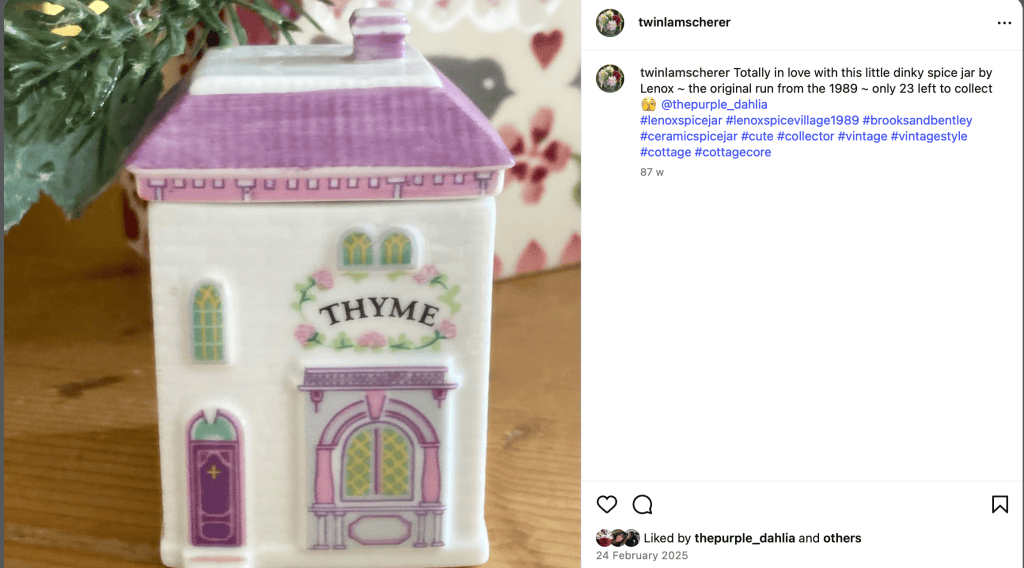
There I was, the proud owner of precisely ONE little porcelain house.
Her name was Thyme, she had a pretty pink roof, and I’d managed to find her on eBay …. not badly priced but not cheap either ….. I was absolutely delighted.
You see, by then I’d already fallen rather spectacularly down the Lenox Spice Village rabbit hole. The original collection of 24 miniature porcelain spice jars, first introduced in 1989, had captured my imagination.
Unfortunately, the prices had also captured my attention.
And not in a good way.
Complete original collections were commanding the sort of money that made me question whether I really needed twenty-four tiny ceramic buildings in my life.
Of course I did.
But I wasn’t about to spend a small fortune acquiring them.
So I’d come up with what seemed a perfectly reasonable solution.
I’d collect them individually.
One little house at a time, whenever I found one at a price I was prepared to pay.
Which explains my rather optimistic Instagram post in February 2025, proudly showing off Miss Thyme with the announcement:
**“Only 23 left to go!”**
Twenty-three.
As though finding another twenty-three reasonably priced, matching porcelain houses would be a straightforward little weekend project.
Oh, the innocence.
🏡 And Then There Was the Reissue
The Lenox Spice Village had originally been produced in 1989, and over the decades it had developed a devoted following.
Its appeal wasn’t difficult to understand.
Twenty-four beautifully decorated little houses, each with a removable roof and its own individual personality. A miniature village that was as decorative as it was practical.
And then Lenox brought the collection back.
The 2024 reissue had generated enormous excitement, particularly among collectors who had spent years admiring the originals but couldn’t justify the increasingly extravagant prices.
Suddenly, there was the prospect of buying an entire brand-new village.
All twenty-four houses.
No hunting down missing roofs, no worrying about decades of wear, and no wondering whether the next little cottage would cost the equivalent of a decent weekend away.
Naturally, I was beside myself.
Forget the sensible plan of buying them one by one.
I could have the whole bloody village!
I watched for stock, followed the updates and waited for my opportunity.
And when Lenox finally had the collection available, the excitement was unbearable – At last!!
My credit card was ready.
My little village was waiting.
There was just one minor complication.
📦 Lenox didn’t ship overseas.**
Oh, for fuck’s sake.
🇫🇷 The Small Matter of Living in France
Now, I appreciate that international shipping can be complicated.
But I wasn’t trying to arrange delivery to the far side of the moon.
I lived in France. A perfectly respectable European country, with roads, houses, post offices and everything. Admittedly, anyone who has dealt with French customs and La Poste will understand that international parcels can sometimes take on a life of their own.
But surely there had to be a way to get twenty-four little ceramic houses from America to the Dordogne?
Apparently not through Lenox directly.
So I started looking elsewhere.
And that was when my innocent little collecting adventure took a rather unexpected turn.
Welcome to the Spice Village Gold Rush
If you’ve ever tried to buy something that has suddenly become fashionable, you’ll know exactly what happened next.
The official stock was difficult to obtain, demand was running high, and the secondary market had begun to resemble a gold rush.
I started scouring eBay, daily if not even hourly.
Complete sets of the new reissue were being advertised at eye-watering prices.
Some were approaching the amounts that collectors had previously been asking for the original 1989 collection.
Think about that for a moment.
A newly manufactured reproduction was being offered for the sort of money that had once been associated with a vintage collectible.
Meanwhile, the original market was having something of a wobble.
For years, the appeal of the 1989 collection had been partly tied to its scarcity. If you wanted one, you had to find a surviving set.
Now buyers had another choice.
A brand-new village.
And although the original collection still had its own appeal, the arrival of the reissue appeared to unsettle asking prices.
It was fascinating to watch.
The new collection was being offered at a premium because people couldn’t get hold of it, while the older collection was suddenly facing competition from its own younger sibling.
And there I was, sitting in France, watching both markets and still trying to find a sensible way to buy the bloody thing.
🖤 The Darker Side of the Marketplace
By this stage, I’d also joined several Facebook groups dedicated to Lenox Spice Village.
Initially, I thought they would be rather lovely places to share photographs, admire collections and perhaps find a few reliable sellers.
And to be fair, many of the members were delightful.
There were collectors showing off their villages, helping others identify missing pieces and sharing the excitement of finally receiving their long-awaited sets.
But there was another side.
A rather unpleasant one.
I began seeing repeated warnings from people who said they’d been scammed.
Buyers reported paying for complete collections that never materialised.
Photographs belonging to genuine collectors were being copied and reused in sales listings.
And there were sellers advertising highly sought-after sets without providing a single photograph of the actual collection they were supposedly selling.
Instead, they’d use the official Lenox promotional images.
Now, let’s be clear. Using a manufacturer’s photograph doesn’t automatically make someone a scammer.
But if you’re asking someone to part with hundreds of euros for a collectible item, surely the very least you can do is photograph the bloody thing?
Show me the actual houses.
Show me the roofs.
Show me the box, the markings, the condition.
Show me something that demonstrates you have the collection sitting in front of you.
Because a beautifully lit promotional photograph tells me what Lenox manufactured.
It tells me absolutely nothing about what YOU are selling.
And that distinction matters.
🛍️ The Reseller in Me Was Twitching
Perhaps I was looking at things differently because I wasn’t just a collector.
I also run Maison Adorée, where I sell vintage and collectible homewares to customers around the world.
I know how important photographs, descriptions and trust are when you’re buying something you cannot physically inspect.
If an item has a flaw, I photograph it.
If there’s a mark, I show it.
If it’s rare or expensive, I make sure the buyer has enough information to make a properly informed decision.
So watching people being tempted into expensive purchases based on borrowed photographs made me distinctly uncomfortable.
And the more I investigated, the more cautious I became.
Some listings were simply overpriced.
Others came with shipping restrictions or eye-watering international delivery charges.
And a few raised enough questions that I wouldn’t have touched them with a bargepole.
It wasn’t that every marketplace seller was dishonest. Far from it.
But when demand is high and buyers are desperate, the opportunists inevitably come out to play.
And I had absolutely no intention of becoming someone’s cautionary tale in a Facebook group.
🔎 The Hunt Goes On
The trouble was, none of this had diminished my enthusiasm.
I still wanted that village.
Miss Thyme was lovely, but she was looking rather lonely.
And my original plan of finding another twenty-three houses individually wasn’t exactly progressing at lightning speed.
So I kept looking.
I compared prices.
I investigated shipping options.
I considered different sellers.
I watched listings appear and disappear.
And every time I thought I’d found a possible solution, another obstacle seemed to pop up.
Either the seller wouldn’t ship to France, the delivery charges were ridiculous, or the asking price was so inflated that I couldn’t bring myself to pay it.
It was becoming an exercise in frustration.
All this effort for a collection of miniature spice jars.
And I don’t even use that many spices.
But by this point, it had become something of a mission.
Then, quite unexpectedly, the answer came from an entirely different direction.
🕺🏻 Enter Dave
Dave was an American client whose property purchase I’d handled here in France.
He’d been extremely appreciative of the help I’d given him throughout the process and had kindly offered to help if there was ever anything he could do.
Well.
As it happened, there was.
I had a slightly unusual favour to ask.
Would he, by any chance, be willing to bring a Lenox Spice Village over from America on his next trip?
Now, Dave is a rather imposing gentleman.
At somewhere around six foot two or six foot three, he’s not exactly someone you’d overlook in an airport queue.
And I suspect that when he offered to help, he hadn’t anticipated being recruited into the international transportation of miniature porcelain real estate.
But bless him, he agreed.
And not only did he bring the collection over, he carried the entire village in his hand luggage.
Yes.
🏡Twenty-four little ceramic houses. In his cabin bag.
Apparently, his luggage attracted a few sideways glances when it went through airport security.
I can only imagine the scene.
A great big American gentleman standing beside the scanner while the security staff contemplate what appears to be an entire residential development packed into his bag.
Perhaps they thought he was an architect.
Perhaps they wondered why anyone needed twenty-four miniature buildings on an international flight.
Or perhaps they decided that some questions were best left unanswered.
Whatever the explanation, Dave and his porcelain village made it safely across the Atlantic.
🤩 July 2026 — At Last!
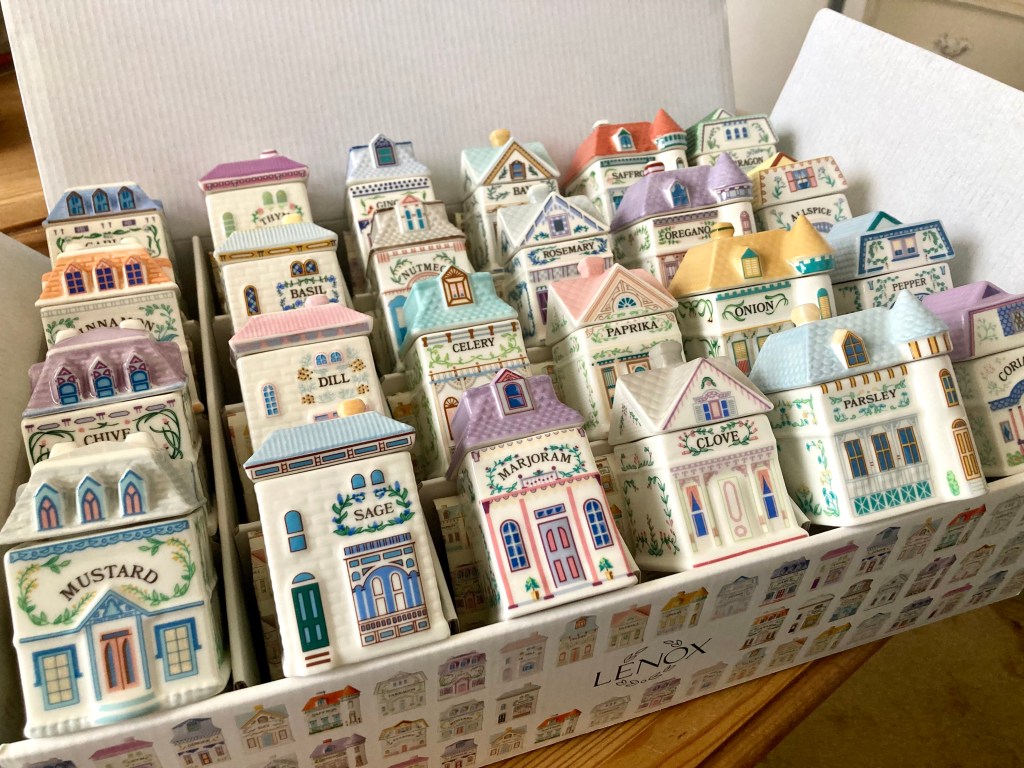
It was July 2026, just a few days before my birthday, when the collection finally made its way to me here in the Périgord Noir.
Seventeen months after that triumphant little Instagram post featuring my €15 Miss Thyme, I finally had a complete Spice Village in front of me.
Not the original 1989 collection I’d initially planned to assemble one house at a time, but the beautiful 2024 revival.
All twenty-four houses.
No more hunting.
No more inflated marketplace listings.
No more wondering whether I’d ever find someone willing to get the collection across the Atlantic.
And certainly no more staring at the Lenox website wishing they’d deliver to France.
Thanks to one very obliging American gentleman, my little village had finally arrived.
And there was something rather wonderful about that.
I’d spent so long watching other collectors receive their sets, reading about the difficulties people were encountering and trying to navigate the international marketplace myself.
Yet in the end, the solution had come through a completely unexpected connection.
A property purchase in France.
An American client.
And a cabin bag full of porcelain houses.
You really couldn’t make it up.
🏡 But Miss Thyme Had Other Ideas
You would think that after seventeen months of searching, I would have been perfectly content.
And I was. Truly.
I was enormously touched by the trouble Dave had gone to, bringing an entire porcelain village across the Atlantic in his hand luggage. The 2024 collection was beautiful, and I was delighted finally to have all twenty-four little houses in front of me.
But there was one small problem.
Miss Thyme.
My original €15 discovery from Leboncoin was still sitting there, quietly minding her own business.
And one day, I picked her up.
I looked at her little pink roof, her softly coloured decoration, the finish of the porcelain. Then I picked up one of the newer houses and began looking more closely.
And that’s when I felt it.
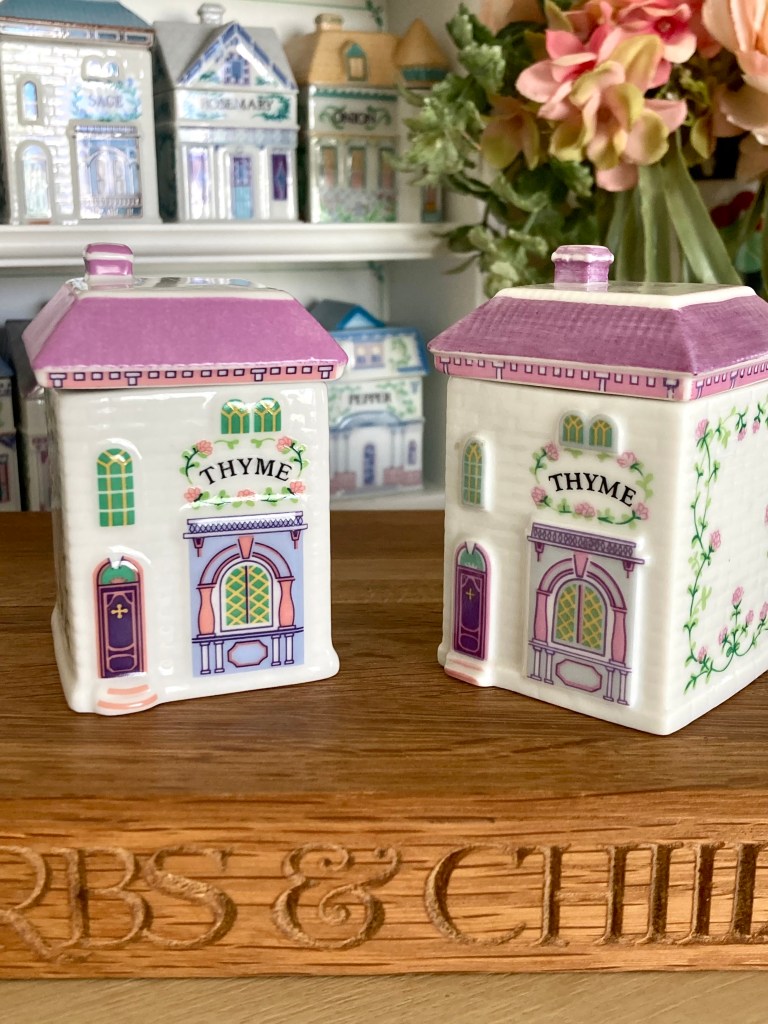
A little wedge.
Something I couldn’t quite put my finger on at first.
The newer houses were lovely. Their colours were brighter, their decoration more defined, and they had all the charm of the original designs.
But something about them wasn’t speaking to me in quite the same way.
Now, I must stress that this is entirely personal.
I’m not suggesting that the 2024 collection is inferior, or that anyone who prefers it is wrong. Quite the opposite. I can completely understand why so many people adore the revival.
But I’ve always been drawn to old things.
Objects that have already lived a life. Things with a little history, a little character, perhaps even the occasional imperfection.
I love wondering where they’ve been, who owned them, and how they came to survive long enough to find their way into my hands.
It’s one of the reasons I started Maison Adorée in the first place.
And somehow, holding that little 1989 house beside its modern counterpart, I realised that what I’d really wanted all along wasn’t simply a complete Spice Village.
**I wanted an original Spice Village.**
Which presented another problem.
I still wasn’t prepared to spend a fortune buying one.
Then I had an idea.
What if I sold the 2024 collection?
The reissue was still attracting considerable interest, particularly from buyers who couldn’t easily obtain one.
Perhaps I could sell mine and use the proceeds to fund the original collection I’d wanted from the beginning.
And so, after all that effort to get twenty-four little houses across the Atlantic, I made the rather extraordinary decision to put them up for sale.
Not because I didn’t appreciate them.
Not because I regretted acquiring them.
But because Miss Thyme had reminded me what kind of collector I really was.
And just like that, the hunt began all over again.
—
*From Maison Adorée, Montignac-Lascaux, in the heart of the Périgord Noir.*
*Next in Lenox Wonderland: The original 1989 village, the 2024 revival, and the little differences that tell a much bigger story.*


Leave a Reply